Career discovery for grades 10 to 12

Who couldyou become?

A 3D world where high-school students explore careers, try real work and see who they are becoming.

Students join through their school.

How WeGuide works

One town. Three islands.

Career Town is home for all three years. Each school year has its own island, and its own question.

Career Town

Your home base for all three years

Build your portfolio, plan your university applications, and meet your counselor and mentors.

One island for each year

Choose a building to see what you do there.
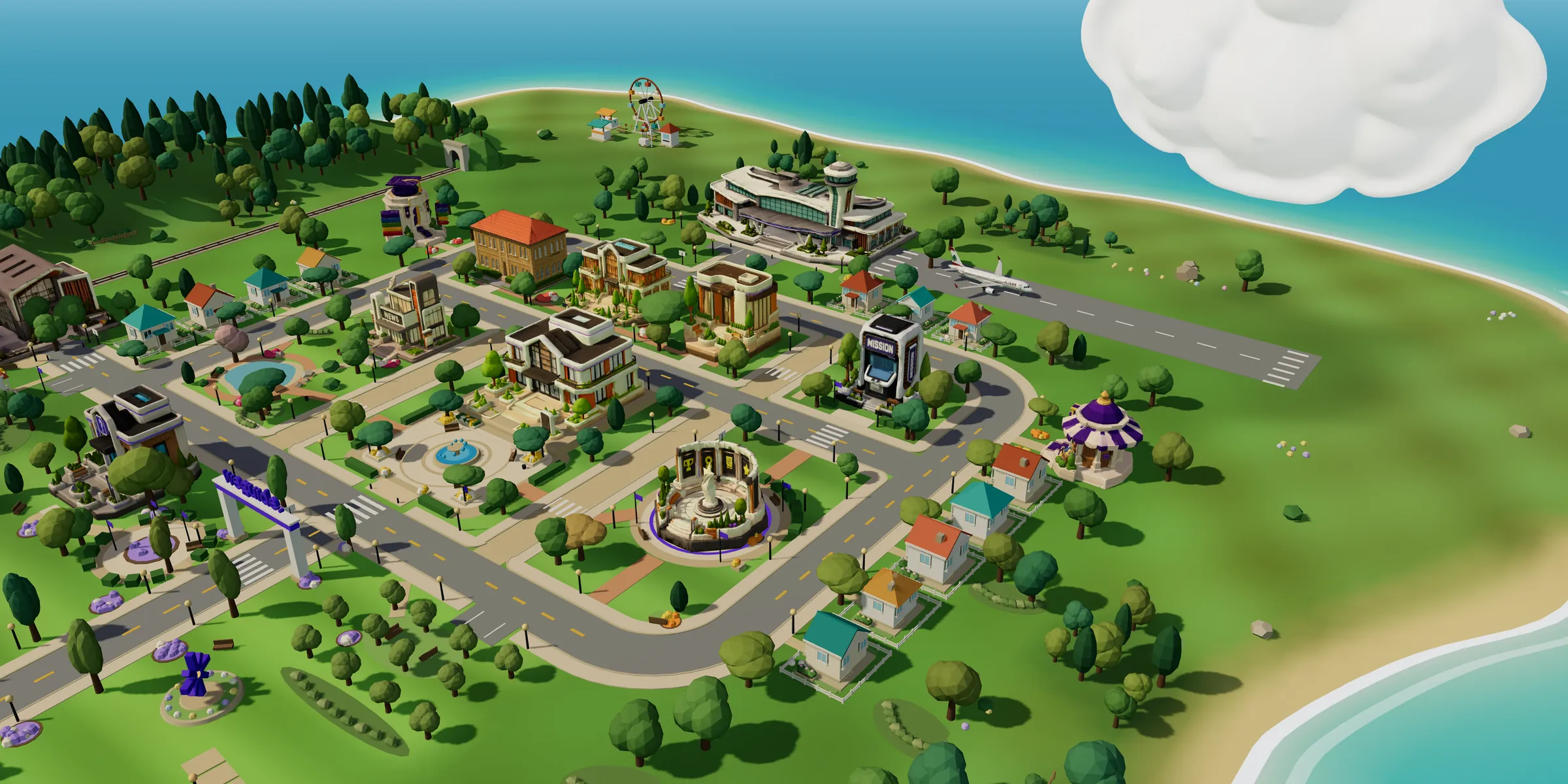
Career Town from above on a sunny day: low-poly buildings around a central square, the airport and its runway, and the sea behind.

Welcome to your town.

Choose a building to see what you do there.
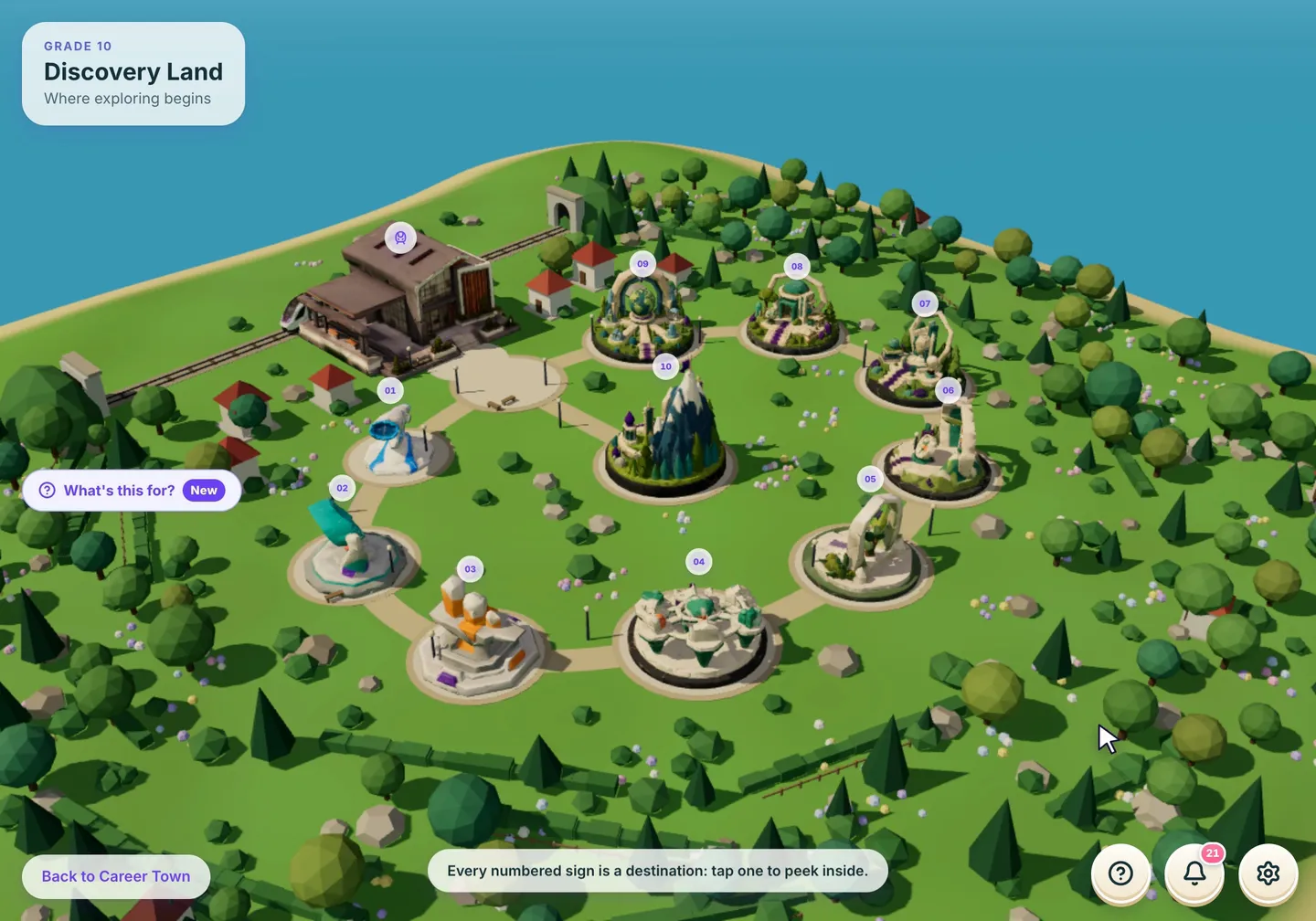
  1. A student in Discovery Land opens Strengths Through Action, looks back at their own answers, saves an Energy Snapshot, and finishes the field mission.

    Grade 10Discovery Land

    Discover.

    Find your interests, your strengths and what matters to you.

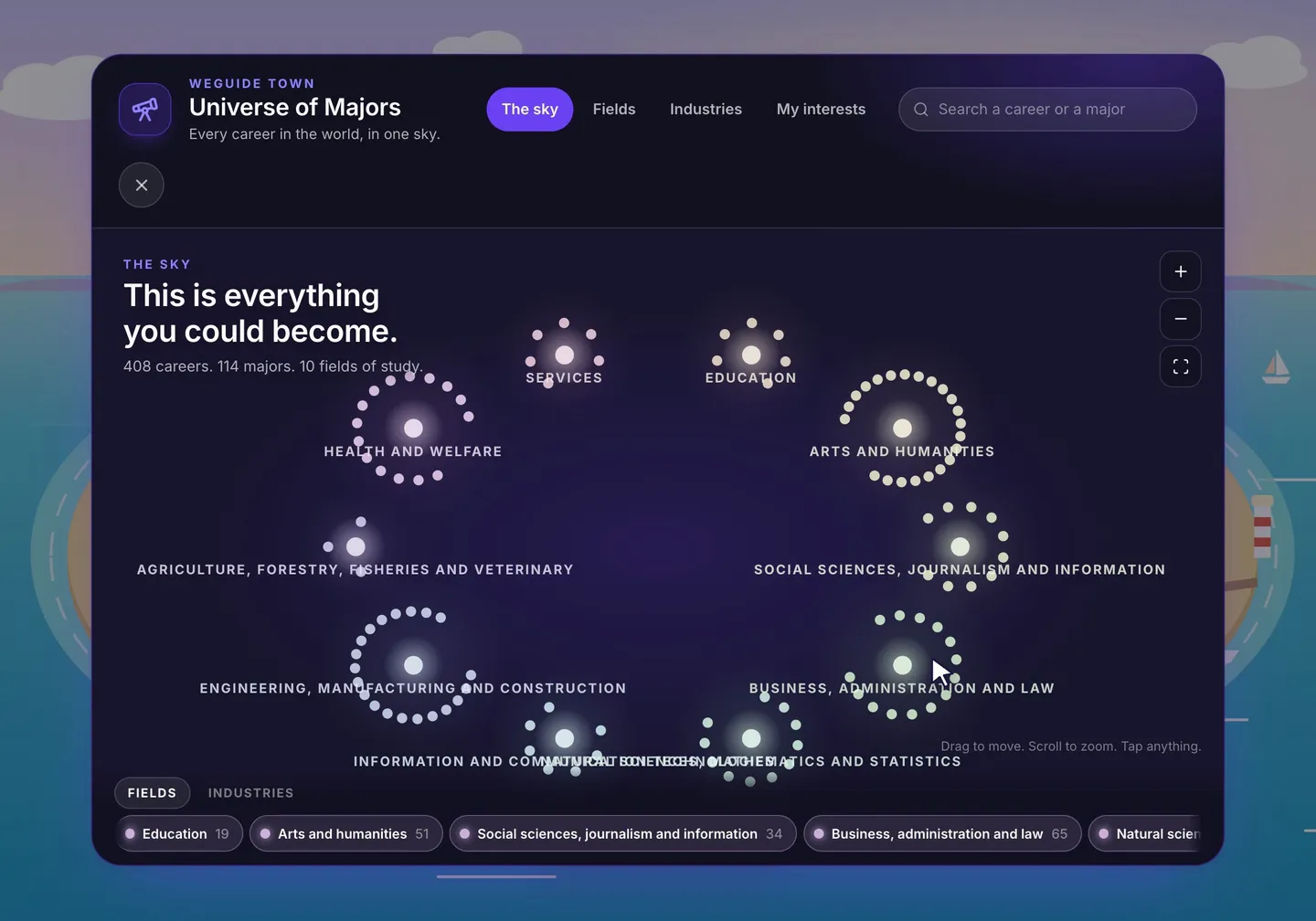
  2. In the Universe of Majors a student flies into Engineering, marks Biomedical Engineering as very interesting, rates the real tasks of the job, and reviews their pathways board.

    Grade 11Decision Land

    Decide.

    Look behind real careers, compare majors and test your ideas before you choose.

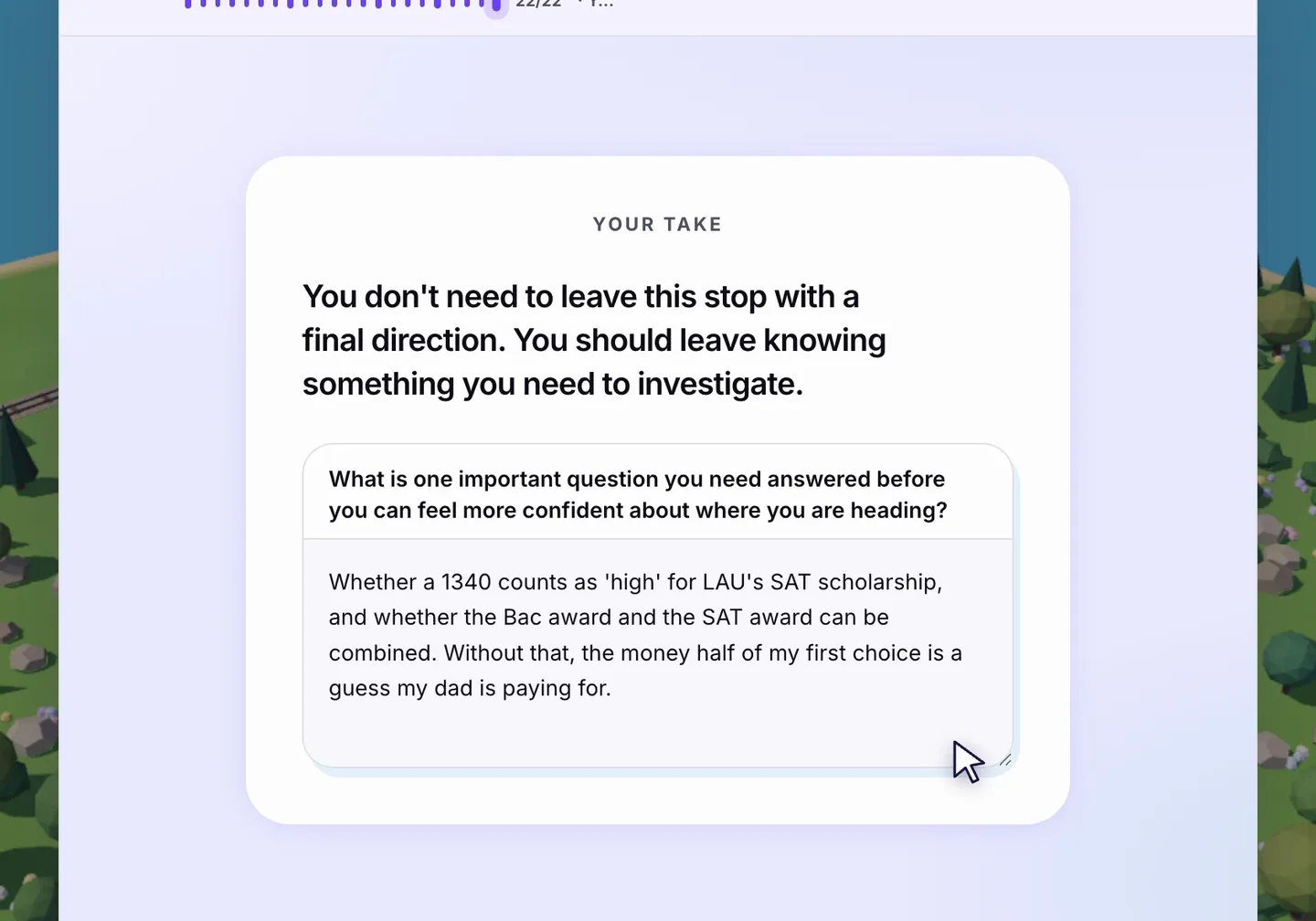
  3. In the University Planner a student brings forward a university from last year's research, saves another, and rates the two on cost to see which fits better.

    Grade 12Launch Land

    Launch.

    Find the evidence in what you have done, and use it to apply to university.

What it adds up to

Three years. One clear picture.

Through each school year, what a student did becomes a report. By Grade 12 it is a record of who they are becoming, with the evidence behind every line.

  1. 01Grade 10 · Report 1

    A first picture.

    After her first destinations, the report names a direction and says how sure it is: science, with medium confidence, from one report.

    65top career fit

  2. 02Grade 11 · Report 2

    The picture sharpens.

    New evidence moves careers up and down, and the report says exactly what changed.

    #18 → #1Biomedical Engineer

  3. 03Grade 12 · Report 3

    A clear direction.

    By Grade 12 the evidence points one way: healthcare, with high confidence, from three reports.

    96top career fit

  4. 04Pathways

    Every fit shows its working.

    A fit adds up visible parts: her interests, what she saved, her marks, her experience and her skills. It measures today's evidence. It does not predict the future.

    59 + 17 + 4 + 5 + 8= 93 for Bioinformatician

  5. 05Skills

    Skills, with proof.

    Each skill shows the evidence behind it, and which parts come from outside the student, like an adult who confirmed it.

    6skills, each with its evidence

  6. 06The brief

    One page for the meeting.

    All of it on one printable page, for a counselor, a student and a parent around one table.

    1page

For schools

  • A dashboard for every student: pathways, skills, growth and evidence.
  • A one-page brief to print for a meeting with a student or a parent.
  • The direction across three years, not one test on one day.
WeGuide for schools

For students

  • Reports through the year, in plain words, in their Portfolio.
  • What they are good at, and the evidence for it.
  • Small next steps they can take this term.

How we know

Science you can check.

WeGuide uses AI to read what a student writes. It never decides who they are. Every line in a report has to be backed by the student's own answers, and checked by rules, before anyone reads it.

What we never do

  • Diagnose a student, or label them "at risk".
  • Tell a student what to become.
  • Send a student's name to the AI.
  • Show a student's report to other students or other schools.
  • Open a student's writing without a written reason. Every look is recorded.

Built on research

Grounded in real jobs.

Careers on WeGuide are described with O*NET, the U.S. Department of Labor's database of what jobs involve, built by surveying the people who do them. University majors follow UNESCO's international classification.

410careers, 404 of them described with O*NET data

Proof first

Nothing is said without proof.

A report can only say something about a student if their own answers show it. One answer is a hint. Answers from different parts of the journey make a pattern.

  • A hint1 answer
  • A pattern2 answers
  • A strong pattern3 answers, from 2 or more places

People in charge

AI drafts. Rules check. People decide.

AI writes a first draft. Rules test every line against the student's answers. Anything that fails is held back for our team.

  1. AI
  2. Rules
  3. People

How a report is made

  1. The student exploresActivities, reflections and real-world missions, over months.
  2. AI draftsIt reads the answers and suggests what they show, pointing to each one.
  3. Rules checkEvery suggestion is tested against the answers. Weak ones are refused.
  4. A clear reportStrengths, directions and next steps, in plain words.

In Yara's Grade 12 report

13 suggestions. 10 kept. 3 refused.

The AI suggested 13 things about her. The rules kept the 10 her answers could support and refused 3, before anyone saw them.

This page includes information from O*NET 31.0 by the U.S. Department of Labor, Employment and Training Administration (USDOL/ETA). Used under the CC BY 4.0 license. O*NET® is a trademark of USDOL/ETA.

Counselors

Her counselor, on the same page.

Every student has a counselor at their own school. WeGuide gives them the same evidence the report is built on, so their time goes to the conversation, not the paperwork.

  • Meetings, booked in the townThe counselor opens times; the student picks one in the Counseling Center.
  • Small goals, with datesShort commitments set together, and a follow-up after each one.
  • Feedback on every missionConfirmed, or sent back with a note on what to try next.
  • Only their own studentsEvery record a counselor opens is logged for the school, and access ends when the assignment does.
Ms. Rania KhouryYara's counselor, at a school in BeirutMs. Khoury is invented, like Yara. The screens are drawn from the real Counseling Center.

Mentors

Someone who does the work.

Professionals around the world, from Montréal to Sydney, meet students in short one-to-one talks online about the work they do.

These mentors are invented to show the Mentorship Hub. Real mentors are invited by WeGuide.

Zeina Itani

Lawyer

Mexico City, Mexico

12,380 km from Beirut

Speaks: Arabic, Spanish, English

Online talk, 15 to 60 minutes

Mentors around the world

Safe by design

  • Talks happen online only, on Google Meet, Teams or Zoom.
  • Profiles carry no phone number, email or social account.
  • A mentor sees only the student's name, grade, school and message.
  • The student's counselor is told about every confirmed talk.
  • Anyone can offer to mentor. Only people WeGuide reviews and invites can meet students.

Give a student 30 minutes of your working life.Become a mentor

Our team

The people behind WeGuide.

A small team building one place where a student can find out who they could become.

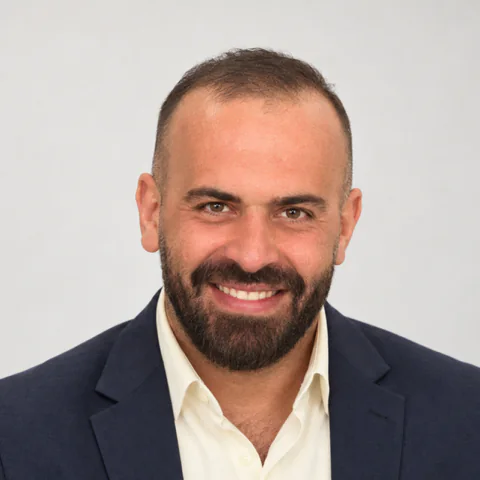
Career Town from above, with each member of the team standing over a building: the CEO at Central House, Strategy and Product at the Airport, Academics at the Library, Business and Software at the Marketplace, Marketing at the News Station.

Choose someone to find them in the town.

Questions

Good questions, straight answers.

What parents, students and schools ask us most.

Still wondering about something?

Ask us directly
What is WeGuide?

A 3D world where high-school students in Grades 10 to 12 explore careers, try real work and find out who they are becoming, over three years and alongside their school.

Does WeGuide tell my child what to study or become?

No. It shows directions and the evidence behind each one, and the student decides. A career fit is a score of how well today's evidence matches a career, not a prediction of the future.

Does it replace the school counselor?

No. The counselor uses it: they book meetings with the student, set small goals together, give feedback on every mission, and read the same report the student does.

Is my child's information safe? Who can see it?

A student sees their own work. Their counselor sees only the students assigned to them, and every record a counselor opens is logged for the school. Other students and other schools see nothing.

How is AI used?

AI writes a first draft of each report from the student's own answers. Rules then test every line against those answers, and anything that fails is held back for our team. The AI never receives the student's name.

How does a student join?

Through their school. The school creates each student's account, so there is nothing to sign up for. To find out whether your school is on WeGuide, use "Is my school on WeGuide?" on this page.

Are the mentor talks safe?

Talks happen online only, on Google Meet, Teams or Zoom. Mentor profiles carry no contact details, a mentor sees only the student's name, grade, school and message, and the student's counselor is told about every confirmed talk.

What does a student need to use it?

A web browser on a laptop, a school Chromebook or a tablet. There is nothing to install.

Get in touch

You don't have to choose yet.Explore first.

Whoever you are, there is one right place to start.

  • Students

    You join through your school. Check whether it is on WeGuide.

  • Parents and guardians

    Write to us with your child's school and grade. We reply within 3 working days.

    Write to us
  • Schools

    For enrolment, rosters, counselor access and dates. We reply within 3 working days.

    Tell us about your school

Worried about someone's safety? Write to safeguarding@weguideworld.com. We read it every working day.

All the ways to reach us